


Are Inflatable Tents Actually Good? Two Years of Real Experience
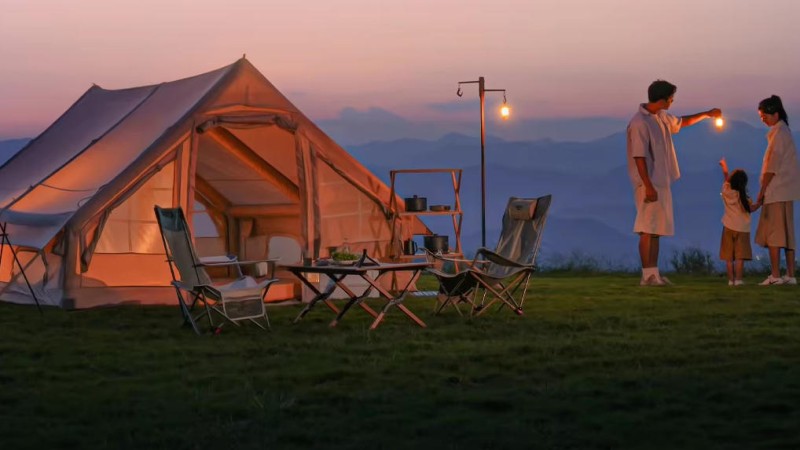
I Spent Three Months Overthinking This Purchase
I went back and forth for about three months before I finally bought an inflatable tent.
Watching reviews, reading forum threads, texting friends who camp—I just couldn't make up my mind. The reason was simple. I didn't trust the idea. A tent that doesn't use poles but holds itself up with air beams? It sounded exactly like one of those cheap inflatable toys you'd get at a fair. Spending a few hundred bucks on something that felt like a giant bouncy castle for the campsite just didn't sit right with me.
But I eventually caved. And what pushed me over the edge wasn't fancy technology—it was my two kids.
Every time we went camping, the scene was always the same chaos. My wife would be trying to keep the kids from running into neighboring sites while I wrestled with pole sleeves, lining up clips, bending fiberglass rods into place. Twenty-five minutes of sweat and frustration. And every five minutes one of the kids would run over asking "are you done yet."
If you've ever camped with young children, you know exactly what I'm talking about.
So two years ago I bit the bullet and bought one. Since then I've used it on maybe twenty-something trips, in all kinds of weather. This isn't a review with ratings and pros-and-cons lists. I'm just going to tell you what it's actually been like.
Does It Really Set Up in Five Minutes?
The five-minute claim isn't total marketing BS. But my first time definitely took longer—maybe twelve minutes or so. You have to figure out how the pump connects, how much pressure is enough, all that stuff.
After two or three tries it gets quick. Stake down the four corners, attach the pump, hit the button, wait a few minutes, and you're done.
The first real trip I took it on, we pulled into camp around six in the evening. Sun was already low. My wife went to grab sleeping bags from the trunk while I started inflating. She hadn't even finished unpacking when I called out that the tent was up.
She turned around: "Wait, seriously?"
I said: "Yep."
I still remember that look on her face.
One thing I learned the hard way though—if it's windy, stake the corners down before you inflate. I tried inflating in gusty conditions once and the tent turned into a giant sail before it had enough pressure to hold its shape. Almost blew away. Now I always peg it down first and it's totally fine.
How Durable Is It Really?
I know this is what everyone worries about. I worried about it too.
Let me start with wind.
I spent a night at a lake campground where the forecast said gusts around thirty miles per hour. The fly was flapping loud enough that I actually got up twice in the middle of the night to check if the stakes were still in the ground.
Everything held. The tent didn't move at all.
What I learned later is that air beams actually handle bending forces better than traditional poles. Those sectional metal or fiberglass poles are weakest at the connection points—that's where they snap or bend. Air beams don't have connection points. They're continuous, so force distributes evenly across the whole thing.
At eight PSI, the beams feel like hard plastic pipes. Wind just doesn't bother them.
Punctures though. That's the real weak spot.
I watched a guy at a neighboring site have his inflatable tent deflate on him once. Probably a stray tent peg or a sharp branch poked through. Half the tent slumped over and it looked like a disaster.
But two things surprised me. First, it didn't fully collapse because the beams have separate chambers—only one chamber went down and the rest stayed standing. Second, he patched it with the included repair kit in maybe ten minutes, pumped it back up, and went on with his trip like nothing happened.
So yes, punctures can happen. But it's not the catastrophe you might imagine. Fixing it is honestly easier than patching a bike tire.
The Interior Space Surprised Me the Most
This is what I didn't expect.
With traditional tents, I always felt like I was fighting for room even when the tent was supposedly big enough. Traditional poles have to curve into an arch to tension the fabric, which means the walls slope inward. You end up with usable space only in the middle—the edges are wasted. You can't sit up near the walls, you bump your head if you move too close.
Inflatable tents are different. The air beams can stand straighter, so the walls are much more vertical. My tent is six point three square meters, but it feels way bigger than traditional tents with the same footprint.
I'm five foot ten and I can stand fully upright inside. Not hunched. Not slouched. Actually standing.
That matters more than I expected, especially on rainy days when everyone's stuck inside. Being able to stand up and move around without crawling makes a huge difference in how you feel after a few hours in the tent. The kids can play without kicking the walls, you can sit in a chair without your shoulders rubbing against the fabric. It's a completely different experience.
Three Things You Need to Accept
It's not all perfect though.
First, the weight.
A four-person traditional tent runs about twelve to eighteen pounds. An inflatable of the same size is usually eighteen to twenty-five. If you're car camping and just walking a few yards from the trunk to the site, you won't care. But if you're carrying your gear any real distance, don't even think about it.
Second, the pump.
This sounds ridiculous, but people actually forget it. I saw a guy at a campground once who had his brand new tent and no pump. Just standing there staring at it.
My rule now is simple—the pump stays in the tent bag at all times. I never take it out separately. Same with stakes, guy lines, repair kit. Everything in one bag.
Third, the price.
Inflatable tents run about thirty to fifty percent more than traditional tents of similar quality and size. I justified it to myself by thinking of it as paying for time and ease. Twenty minutes saved per trip adds up to hours over a season. For me that's worth the extra cost. But everyone's situation is different.
Who Should Buy One?
If you camp with kids, I strongly recommend one. Less setup time means fewer meltdowns from tired hungry kids, and that alone makes it worthwhile.
If you're new to camping, the learning curve is almost zero. You don't need to figure out poles and clips.
If you're older or have a bad back, not having to bend over and wrestle with poles is a genuine relief.
If you winter camp, get one with a stove jack. You'll be cooking and sleeping warm while it's freezing outside.
On the other hand, if you're an ultralight backpacker who obsesses over every ounce, this isn't for you. If you're on a tight budget, skip it. Traditional tents work perfectly well—I used them for years and never had any real problems.
What to Look For When Buying
TPU beams are better than PVC. They're lighter, more flexible, and don't stiffen up in cold weather.
Get at least four hundred twenty denier Oxford fabric. Anything thinner is asking for trouble.
Waterproof rating should be at least two thousand millimeters. Anything lower and moderate rain can start to leak through.
And don't overlook UV protection. Sun exposure ages every tent and it's especially hard on air beams. Make sure whatever you buy has UV-resistant treatment.
The SolisCamp six point three square meter inflatable tent checks all those boxes. Four twenty denier Oxford, UPF fifty plus sun protection, true four-season capability, and a stove jack for winter use. You might not have heard of them, but they've been doing solid work on inflatable tents the last few years. Worth a look if you're shopping around.
Final Thoughts
I'm not writing this to convince you to buy an inflatable tent.
I'm also not trying to prove it's better than traditional tents. Camping gear is never about the best—it's about what works best for you.
How you camp, who you camp with, how much time you want to spend setting up and tearing down. If you're like me—camping with kids on weekends, wanting to spend less time wrestling with poles and more time actually being there—then an inflatable tent is probably going to work out just fine.
Hope you get to watch more sunsets and fight fewer poles.