


How to Choose an Inflatable Tent A Practical Guide After of Camping
Last year someone in a camping group chat asked what tent I used. I said inflatable. Then a few people messaged me privately asking pretty much the same things. Is it easy to set up. Does it blow away in the wind. Is it actually better than a regular tent.
After that I started paying more attention at campgrounds. I noticed more people using inflatable tents than I expected. But I also saw some interesting stuff. People spending good money on quality tents and not knowing how to use them properly. People buying cheap inflatable tents and regretting it after one trip.
So I figured I would put together a practical buying guide. Not copied from spec sheets somewhere. Not sponsored. Just based on what I have seen at campgrounds over the past couple years, conversations with other campers, and some lessons I learned the hard way.
My Four Criteria for Evaluating Inflatable Tents
I want to be clear about what I look for before I get into specific tent types. This way you understand where I am coming from.
First is beam material. I have used both TPU and PVC and the difference is noticeable. TPU is lighter and more flexible. It stays soft in cold weather. PVC is cheaper but gets stiff when temperatures drop and tends to develop creases over time. If your budget allows, TPU is the better choice.
Second is fabric quality. Four hundred twenty denier Oxford cloth is my minimum standard. Anything below that, I do not consider. It is not necessarily terrible but durability does take a hit. A sharp branch or a rough rock can do more damage than you would expect. For family camping, 420D is a safe starting point.
Third is ease of setup. This is not just about inflation speed. It is also about whether the pump is user-friendly, whether the valve placement makes sense, and whether deflation goes smoothly. Some tents inflate quickly but are a pain to deflate, leaving you sweating and frustrated at pack-up time. I have been there so I pay attention to this now.
Fourth is waterproofing and sun protection. At least two thousand millimeters of water resistance, no negotiation. UV treatment matters too because both beams and fly fabric degrade under constant sun exposure. Good UV protection adds years to a tent's lifespan.
Entry-Level Inflatable Tents Light and Affordable
These tents typically use PVC beams with fabric around two hundred to three hundred denier Oxford cloth. PVC keeps costs down. The downsides are extra weight and stiffness in winter. But for first-time buyers on a budget, these are reasonable trade-offs.
Setup takes about eight to twelve minutes. Because the beams are thinner, they do not require much air volume. A small pump gets the job done. Deflation is quick too, and rolling the tent back into its storage bag is not difficult. Packed size is reasonable and does not take up much trunk space.
Door and window openings on these tents are usually basic. One door at each end, maybe two or three small windows. The interior is not huge. These are mostly two or three-person tents. Four-person versions are rare because the materials and structure do not support larger spans.
Who is this for. New campers on a budget. People who want to try inflatable technology without committing to a big purchase. If it turns out you do not like inflatable tents, you have not lost a lot of money.
Who is this not for. Experienced campers. Anyone planning to use a tent in rough weather or winter conditions. The materials have limits and it is better to be aware of that upfront.
Family-Style Inflatable Tents Spacious with Good Details
This is the category I use most often myself. The beams are usually TPU, and the fabric is four hundred twenty denier Oxford cloth or higher. Some go up to six hundred denier. The overall build quality is significantly better than entry-level tents, and durability is on a completely different level.
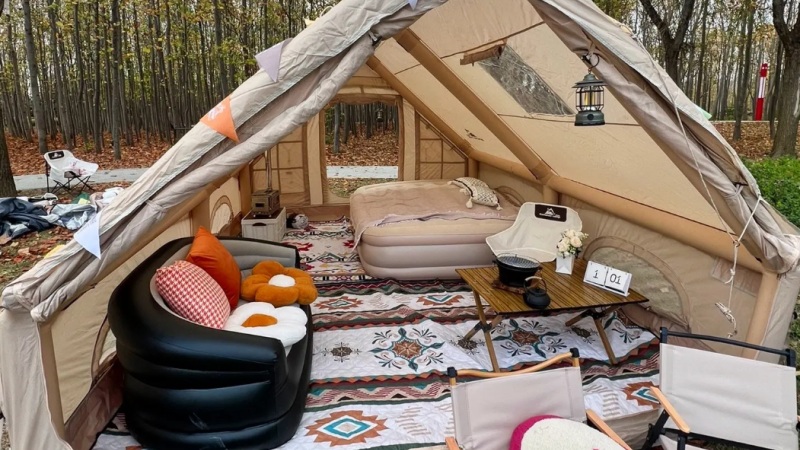
What really stands out is the interior space. Traditional tents have curved poles that make the walls slope inward, wasting the corners. Inflatable tents have beams that sit straighter, so the walls are closer to vertical. With the same floor area, you get much more usable space. Being able to stand upright inside makes a huge difference, especially on rainy days when the whole family stays inside the tent.
Setup time is around five to eight minutes once you are familiar with it. The valve design matters a lot here. Good valves can be operated with one hand. Bad valves require two people to align properly. Some tents have built-in pumps, which are convenient but harder to repair if something goes wrong. External pumps are easier to replace but you need to remember to bring them.
Family tents usually have two or three doors and four to eight windows. Good ventilation keeps the interior from getting stuffy in summer, and multiple doors make it easier to get in and out. Dark rest fabric is another feature that gets overlooked. It blocks morning light and lets everyone sleep in.
Storage pocket placement tells you a lot about how well a tent is designed. Some tents just stick a single pocket in the corner. Better designs have pockets at both ends, positioned so you can reach them while lying down. Small details like this become noticeable after you use a tent for a while.
Sealing and waterproofing are major focuses for family tents. Seams at the floor and base are usually taped. Flaps over doors and windows overlap more generously than on entry-level tents. Some designs include a gap between the air beams and the outer fly to allow airflow that prevents condensation while still keeping rain out.
Who is this for. Families. People who want one tent that works year-round. Anyone who does not want to spend a lot of time on setup. This is the most mature and varied category on the market.
Who is this not for. Ultralight backpackers. These tents are too heavy for that use case. If you mostly go solo and carry all your gear, you will want something lighter.
Four-Season Inflatable Tents with Stove Jacks
This type is what I call hot tents. The defining feature is the stove jack. You can install a wood-burning stove inside the tent. When it is freezing outside, you can sit inside in a t-shirt and be completely comfortable. Once you have experienced that, it is hard to go back.
The position of the stove jack and the quality of the heat-resistant material matter a lot. Good stove jacks use multiple layers of heat-resistant fabric with a metal insulating ring around the opening. The chimney passes through without burning or melting the tent fabric. The height and angle of the chimney have to be just right to ensure smoke goes out and does not blow back in.
Beams on these tents are almost always TPU, and they are thicker and stronger than standard ones. Winter camping means heavy snow and strong winds, so the beams need to handle much higher loads. Some designs add protective sleeves around the beams to prevent scratches and provide insulation against extreme cold.
Fabric is usually four hundred twenty to six hundred denier Oxford cloth with a thermal coating on the inside. These tents are noticeably heavier than three-season versions, but the weight is justified by the warmth they provide.
The floor design is also different. To help snow drain away, the edges usually sit slightly higher, allowing meltwater to flow out instead of pooling around the base. The pump requires a bit of attention in cold weather because batteries drain faster at low temperatures. A manual backup pump is a smart addition.
Who is this for. Winter campers. People who enjoy snow camping. Anyone who wants to cook and heat inside their tent. These tents are expensive, but every feature serves a real purpose.
Who is this not for. Summer-only campers. People on a tight budget who will not use the winter-specific features. A significant portion of the cost goes toward cold-weather performance that you would not use in summer.
Lightweight and Portable Inflatable Tents A Middle Ground for Backpackers
These tents were rare a couple years ago but have become more common recently. They keep the convenience of inflatable tents while keeping weight and packed size as low as possible.
The beams are TPU but with thinner walls. The fly fabric is lighter as well, around two hundred denier. The packed size is close to a traditional backpacking tent. The trade-off is lower durability compared to family tents. They need to be handled with a bit more care.
Setup is the fastest among all inflatable tents. Three to four minutes once you have done it a few times. Because the beams are thinner, they fill up quickly. A small pump takes maybe fifteen seconds. Some ultralight versions even allow mouth inflation, though that takes more effort.
Interior space is not a priority here. These tents are designed for one or two people. Do not expect to fit furniture or sit up comfortably. Ceiling height is usually around three to four feet, so you will be crawling rather than walking.
These tents are well suited for campers who stay active across seasons. Lightness and portability are the main selling points. The fabric is often reinforced near the ground to handle moisture and abrasion.
Who is this for. Backpackers. Bikepackers. Solo travelers who want inflatable convenience but need to keep weight down.
Who is this not for. Families. The space is too small. Also, because the fabric is thin, rough weather requires extra caution.
Which Type Is Right for You
Entry-level tents work well for new campers on a budget who want to try inflatable technology without a big commitment. The materials are basic, but the experience gives you a sense of whether this type of tent suits your style.
Family-style tents are the most balanced option. Solid quality, comprehensive features, no obvious weak points. If you want one tent that handles everything, this category has the most choices.
Four-season tents are for winter campers who want to use a stove inside their tent. They are more expensive, but every feature is something you will actually use.
Lightweight portable tents are for backpackers and cyclists. They sacrifice some durability for reduced weight, which makes sense for those use cases.
A Few Details That Are Easy to Overlook
Pump type and user experience vary a lot. Built-in pumps are most convenient but difficult to repair if they fail. External pumps are easy to replace but require you to remember bringing them. Manual pumps are most reliable but require physical effort. My approach is to keep a small manual pump in the car as backup.
Stake and guy line quality directly affect stability. Inflatable tents handle wind well on their own, but if the stakes are the thin wire type, they will bend under pressure. I replaced mine with thicker stakes and noticed a big difference.
Repair kit contents vary by brand. Some include everything you need. Adhesive, patch material, instructions. Others just include two pieces of tape. Check your repair kit before the first trip and add anything that is missing.
Some Common Questions
Do air beams need maintenance. Generally no. Just avoid long-term sun exposure and sharp objects. Check the beam surface for scratches or wear marks after each trip.
Do beams get brittle in winter. TPU beams do not. They handle low temperatures well. PVC does stiffen up in cold weather, so be gentle when folding.
What if the tent gets punctured. Punctured beams can be fixed with the included repair kit in about ten minutes. Rips in the fly fabric can be patched with tent repair tape on site and properly fixed later.
What if the pump battery dies. Electric pumps can be powered from a car outlet or a portable power bank. If you are camping away from a vehicle, bring a manual pump as backup.
How much space does it take in the car. Family tents are larger than traditional tents but still fit easily in most car trunks. Lightweight versions are close in size to traditional backpacking tents.
Final Thoughts
Inflatable tents have come a long way in the last couple years. When I bought mine two years ago, there were not nearly as many options as there are now.
These tents will not replace traditional tents entirely. They serve specific use cases. For family camping and car camping, they are much more convenient than traditional tents. For ultralight backpacking and extreme conditions, traditional tents still have clear advantages.
At the end of the day, the best tent is not about which one is objectively best. It is about which one fits your use case. My choice is inflatable because my use case is camping with kids, driving to the site, and not wanting to spend too much time on setup. If your use case matches, inflatable tents are worth considering. If not, traditional tents remain a solid choice.
Hope this helps.